Hot Runner O-Rings & Seals: Types, Materials & Replacement Considerations
Reliable sealing is essential to the operation of many hot runner assemblies. From valve-gate actuation systems to nozzle and manifold interfaces, specialized sealing components help maintain pressure, manage thermal conditions, and prevent unwanted leakage.
Hot runner O-rings and seals are available in different materials and configurations to accommodate the demanding temperature, pressure, and mechanical requirements of injection molding equipment.
Understanding their functions and differences helps maintenance teams identify replacement components and protect surrounding equipment from avoidable damage.
What Do O-Rings and Seals Do in Hot Runner Systems?
Sealing components are installed at designated locations within hot runner assemblies to prevent unwanted fluid or material movement.
Their specific purpose depends on the application.
For example, seals within pneumatic or hydraulic valve-gate actuators help maintain the pressure required for reliable piston movement.
Other seals may be used at nozzle or manifold interfaces to help maintain melt containment, while certain sealing materials also provide thermal management functions.
These applications require different sealing materials and designs.
A seal intended for an actuator should not automatically be considered suitable for direct contact with molten plastic.
Common Types of Hot Runner O-Rings and Seals
Viton O-Rings
Viton is a well-known trade name for certain fluoroelastomer materials commonly used in industrial sealing applications.
Viton O-rings offer resistance to elevated temperatures and many chemicals, making appropriately specified grades useful in certain hot runner actuator and sealing applications.
Actual temperature and chemical compatibility depend on the specific material grade and operating environment.
HotRunnerSpareParts.com supplies Viton-based O-rings and seals, including configurations with protective PTFE coverings.
PTFE-Coated and Encapsulated Seals
PTFE, commonly known by the trade name Teflon, is valued for its low friction and resistance to many chemicals.
In some sealing designs, PTFE is combined with an elastomeric core to provide a combination of chemical resistance and elastic sealing characteristics.
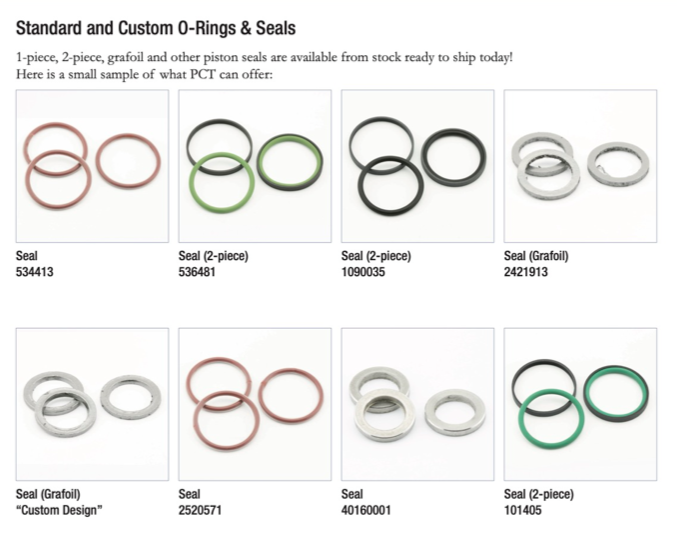
HotRunnerSpareParts.com offers two-piece piston sealing arrangements incorporating Viton O-rings with graphite/PTFE cover sleeves, as well as PTFE-encapsulated Viton O-rings.
Piston Seals
Piston seals are used in certain valve-gate actuation systems to help maintain pneumatic or hydraulic pressure around moving pistons.
These seals must accommodate repeated movement while maintaining the intended sealing performance.
Available designs include one-piece and two-piece configurations.
For example, HotRunnerSpareParts.com lists replacement piston seal reference 2520571 for selected 144-cavity systems and reference 1090035 as a two-piece design for micropitch systems.
Grafoil Seals
Grafoil is a flexible graphite sealing material used in demanding industrial applications.
Within certain hot runner designs, graphite-based seals can help manage heat flow while providing the required fit at their designated interfaces.
HotRunnerSpareParts.com lists Grafoil seal references 2421913 and 3323778, identified as equivalent references in its catalog.
Metal C-Ring and Stainless Steel Seals
Metal seals are used in applications requiring specific sealing performance under elevated temperatures or pressures.
Metal C-ring seals can provide sealing through controlled compression and elastic deformation.
Vented stainless steel seals are also used beneath nozzle housings in certain hot runner designs to help prevent leakage.
The required seal geometry, material, and compression characteristics depend on the original equipment specifications.
Common Signs of Seal Wear or Failure
Hot runner seals may deteriorate through repeated thermal cycling, mechanical movement, pressure exposure, or improper installation.
Potential warning signs include:
Air or hydraulic fluid leakage in actuation assemblies
Reduced or inconsistent valve-gate actuation
Visible cracking, deformation, or wear
Damaged sealing lips or contact surfaces
Loss of sealing pressure
Material leakage at designated nozzle or manifold interfaces
The failure of a small sealing component can affect other parts of the assembly.
For example, a damaged piston seal may interfere with actuator performance, while a compromised metal seal may allow leakage at a critical interface.
How to Identify Replacement Hot Runner Seals
Correct