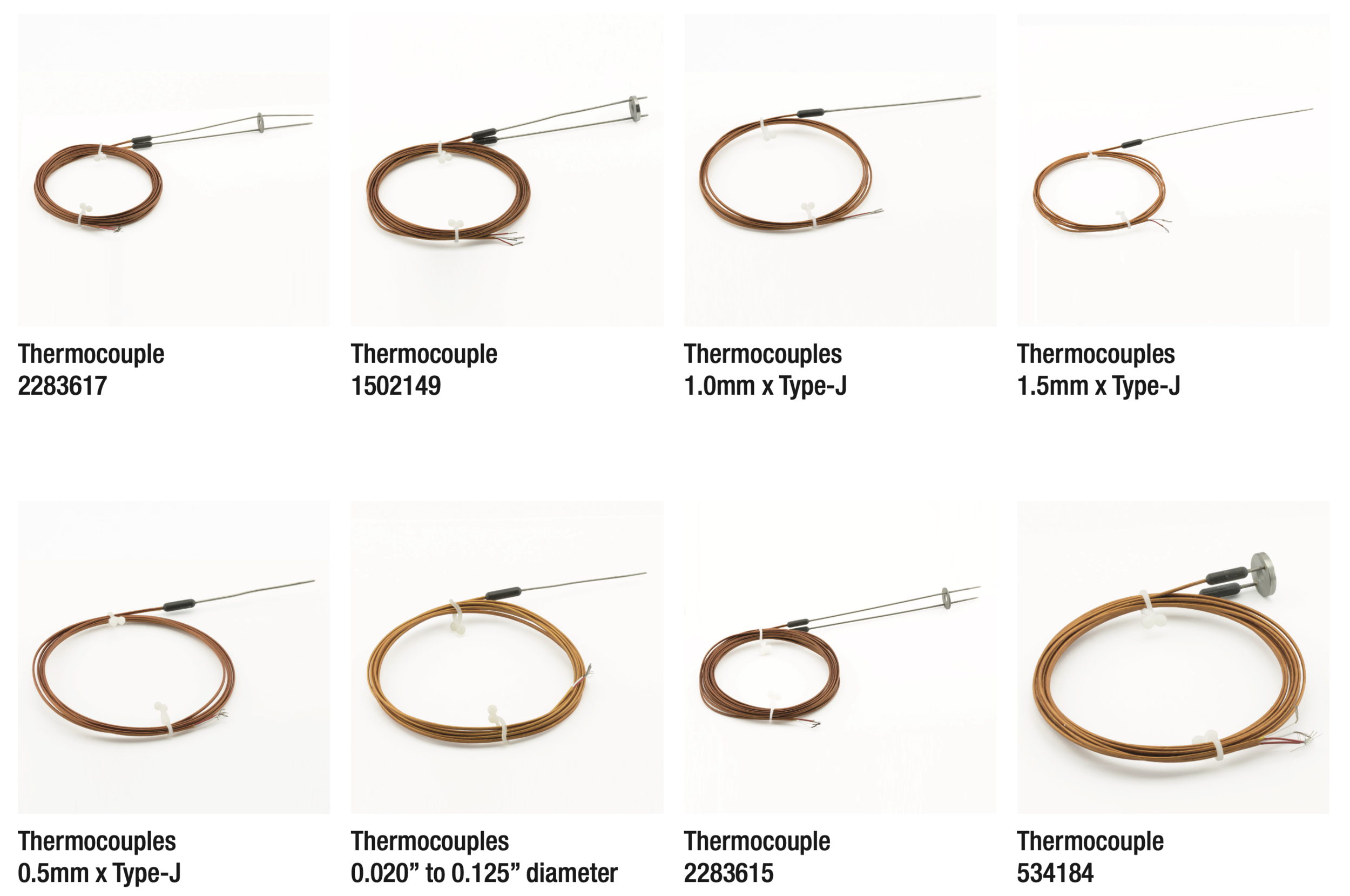
Hot Runner Thermocouples: Understanding Types, Applications & Replacements
Accurate temperature measurement is essential to successful plastic injection molding. When melt temperatures become inconsistent, manufacturers can experience processing instability, material degradation, dimensional variation, or production interruptions.
Hot runner thermocouples help maintain temperature control by providing continuous feedback from heated components to the system's temperature controller.
Understanding the different sensor types and their applications is important when troubleshooting temperature issues or selecting replacement thermocouples.
What Does a Hot Runner Thermocouple Do?
A thermocouple is a temperature sensor made from two dissimilar conductors joined at a measuring junction.
As the junction experiences a temperature difference relative to the reference end of the measurement circuit, it produces a voltage that can be interpreted as temperature.
In a hot runner system, the temperature controller uses this feedback to regulate electrical power supplied to heaters.
Together, heaters, thermocouples, and temperature controllers help maintain the required thermal conditions throughout the hot runner assembly.
A damaged or incorrectly installed thermocouple can produce inaccurate readings or cause a temperature-control fault.
Nozzle Thermocouples vs. Manifold Thermocouples
Thermocouples are installed at different locations depending on the hot runner design.
Nozzle Thermocouples
Nozzle thermocouples monitor temperatures at designated points within nozzle assemblies.
They are commonly designed with small sensor diameters and flexible, mineral-insulated constructions that can accommodate confined installation spaces.
Proper positioning and thermal contact are important for obtaining representative temperature measurements.
Manifold Thermocouples
Manifold thermocouples measure temperatures at specified locations on or within the heated manifold.
These sensors may use different mounting brackets, probe lengths, and termination configurations.
Because manifold and nozzle sensors can differ in shape, dimensions, and installation requirements, they should not be considered interchangeable without verifying their specifications.
Grounded vs. Ungrounded Thermocouples
Another important distinction is whether the thermocouple measuring junction is grounded or ungrounded.
Grounded thermocouples have a measuring junction electrically connected to the protective metal sheath. This configuration can provide a relatively fast response and is suitable for certain applications.
Ungrounded thermocouples have a measuring junction electrically isolated from the sheath. This arrangement can help reduce some electrical interference and ground-loop concerns.
Neither configuration is universally better. The correct selection depends on the equipment design, controller requirements, and installation environment.
Thermocouple Types and Specifications
Thermocouples are also classified by conductor type.
Type J thermocouples, commonly used in industrial temperature measurement, employ iron and constantan conductors. Other thermocouple types may be specified for particular equipment.
When selecting a replacement, verify:
Thermocouple calibration type, such as Type J
Grounded or ungrounded junction
Probe diameter and length
Lead wire length and insulation
Mounting or bracket configuration
Connector or termination style
Required operating temperature range
Different lead-wire coverings, including fiberglass, PTFE, and polyimide-based materials, are available for different operating environments.
The selected wire covering must be suitable for the actual temperature and mechanical conditions.
Signs of a Failing Hot Runner Thermocouple
Common symptoms that may indicate a thermocouple problem include:
Unstable or erratic temperature readings
Open-sensor alarms on the temperature controller
Readings that do not respond normally during heating
Damaged or exposed lead wires
Intermittent temperature feedback
However, these symptoms can also result from damaged wiring, connectors, controller inputs, or heater-related problems.
Before replacing a thermocouple, qualified personnel should inspect the sensor circuit and verify the source of the fault.
Finding Replacement Hot Runner Thermocouples
HotRunnerSpareParts.com offers a selection of hot runner thermocouples, including nozzle and manifold configurations, grounded and ungrounded designs, and multiple probe diameters.
Replacement options are available for various hot runner systems, including HUSKY, Männer, Mold-Masters, MHT, and others.
Need a replacement thermocouple? Contact HotRunnerSpareParts.com with the original part number, sensor dimensions, junction configuration, and required quantity to receive assistance with identification and quotation.